Saturn’s moon Mimas, famous for its Death Star-like appearance, might host an ocean beneath its ice shell. Simulating Herschel, its largest impact basin, can allow us to place constraints on the timing and evolution of that ocean, as in our papers
       
     
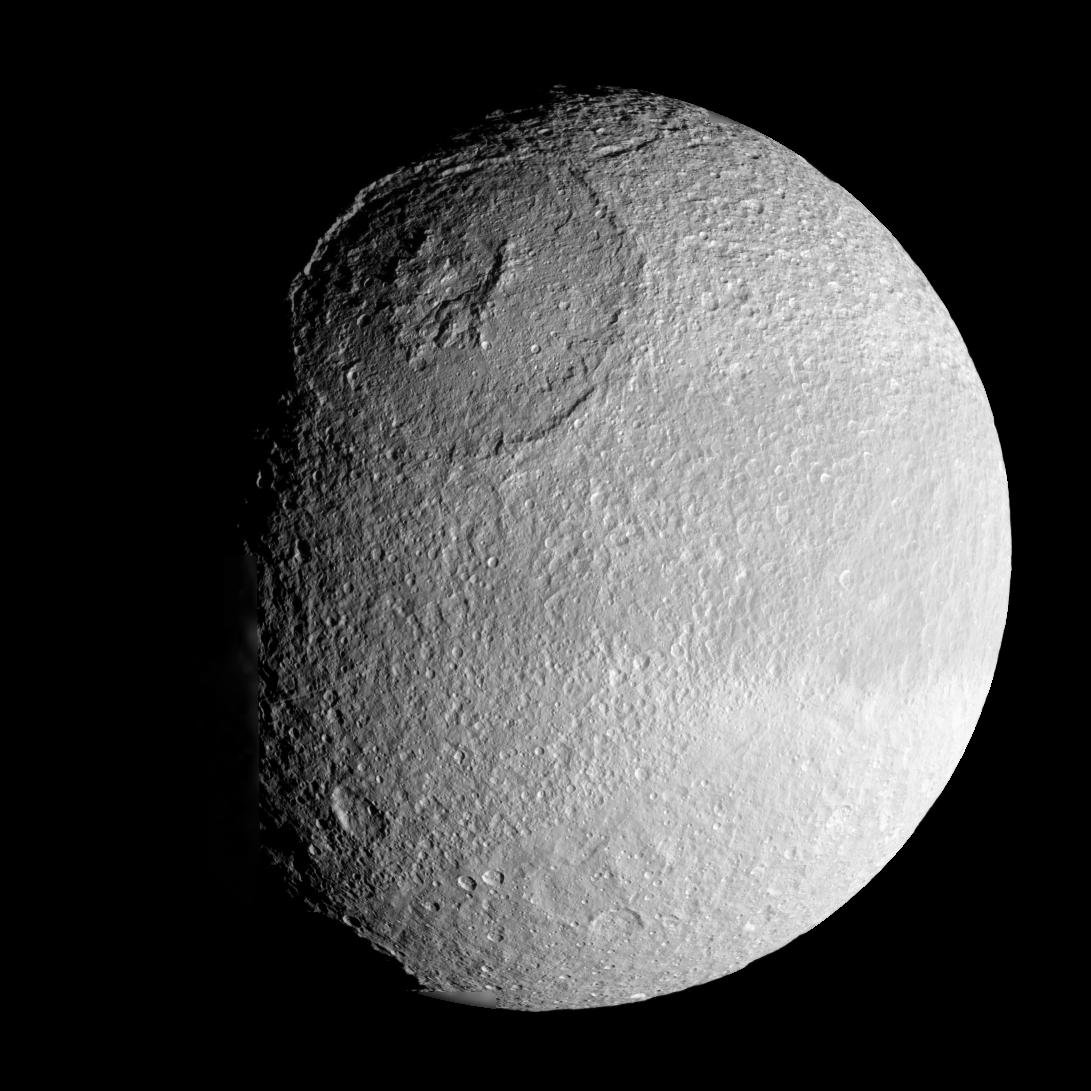
 Saturn’s moon Tethys might have a complex and unusual interior, a fact betrayed by its low density. My ongoing work uses its large impact basin, Odysseus, to probe deeper. (Image via NASA JPL)
       
     
 Dione, another Saturnian moon, appears to have a dramatic tectonic and geologic history, one that’s substantially modified large basins like Evander in the lower right. Ongoing work probes the formation of craters large and small to determine whethe
       
     
 Saturn’s moon Mimas, famous for its Death Star-like appearance, might host an ocean beneath its ice shell. Simulating Herschel, its largest impact basin, can allow us to place constraints on the timing and evolution of that ocean, as in our papers


Saturn’s moon Mimas, famous for its Death Star-like appearance, might host an ocean beneath its ice shell. Simulating Herschel, its largest impact basin, can allow us to place constraints on the timing and evolution of that ocean, as in our papers here and here. (Image via NASA JPL)

 Saturn’s moon Tethys might have a complex and unusual interior, a fact betrayed by its low density. My ongoing work uses its large impact basin, Odysseus, to probe deeper. (Image via NASA JPL)


Saturn’s moon Tethys might have a complex and unusual interior, a fact betrayed by its low density. My ongoing work uses its large impact basin, Odysseus, to probe deeper. (Image via NASA JPL)

 Dione, another Saturnian moon, appears to have a dramatic tectonic and geologic history, one that’s substantially modified large basins like Evander in the lower right. Ongoing work probes the formation of craters large and small to determine whethe


Dione, another Saturnian moon, appears to have a dramatic tectonic and geologic history, one that’s substantially modified large basins like Evander in the lower right. Ongoing work probes the formation of craters large and small to determine whether an ocean has influenced their morphology (Image via NASA JPL).